

Quick Answer
P0420 on a Honda means Catalyst System Efficiency Below Threshold, Bank 1. The monitor has judged the catalyst system’s performance inadequate under its test conditions. This does not identify a converter or oxygen sensor as the failed part. Save codes and freeze frame, investigate misfire and mixture faults, inspect for exhaust leaks, then follow the Honda test for the exact engine and calibration.
What Does the P0420 Code Mean?
The Honda P0420 code indicates a failed catalyst-efficiency monitor. A three-way catalyst treats exhaust pollutants when the engine and exhaust conditions are suitable. The controller evaluates sensor information using its calibrated test. The code reports that result, rather than directly measuring the condition of every part in the exhaust system.
On a Honda V6, confirm Bank 1 using the engine identification and service diagram. Do not assume driver side, passenger side, front or rear from a general code article. A four-cylinder application has a different exhaust layout; use the correct sensor and converter locations for that engine.
The upstream air/fuel sensor may be a wideband device whose displayed signal cannot be compared directly with a conventional downstream oxygen sensor voltage. PID units, scaling, catalyst temperature, engine load and control strategy matter. A universal “less than 0.1 volt difference” rule cannot diagnose Honda catalyst efficiency.
Catalyst efficiency and exhaust restriction are different questions. P0420 alone does not prove the converter is physically blocked. If there is severe power loss, overheating or abnormal exhaust noise, investigate those symptoms with the appropriate tests instead of assuming they are routine consequences of the code.
Honda Accord, Civic, CR-V, Pilot and Odyssey searches all lead to P0420 discussions, but model names are not a diagnosis. Record year, engine, mileage, oil consumption, recent repairs and the complete code set. That information determines which service procedure or bulletin may apply.
Keep catalyst, mixture and misfire codes separate
| Code | General description | Key distinction |
|---|---|---|
| P0420 | Catalyst efficiency below threshold, Bank 1 | Test the correct bank after relevant upstream faults are addressed. |
| P0430 | Catalyst efficiency below threshold, Bank 2 | A separate bank on applicable engines; not a second name for P0420. |
| P0421 | Warm-up catalyst efficiency below threshold | A related but distinct monitor; follow its own procedure. |
| P0300 / P030x | Random or cylinder-specific misfire | A possible upstream problem that can damage a catalyst. |
| P0171 / P0172 | System too lean / too rich, Bank 1 | Mixture evidence must be investigated rather than ignored. |
Honda-specific evidence: Bulletin 22-040, dated September 21, 2022, calls for a software update and subsequent catalyst evaluation on listed 2014–2016 CR-Z vehicles. Bulletin 14-002 concerns specific 2010 vehicles and an A/F-sensor-cap failure affecting the warm-up catalyst. These examples show why model/VIN eligibility and the prescribed tests matter; neither is a universal Honda repair.
P0420 Symptoms and Likely Causes
A steady malfunction light with otherwise normal operation is a common presentation. Noticeable misfire, rich running or power loss may identify a companion fault requiring attention before a meaningful catalyst test.
The catalyst monitor may fail without a clear change in driving behavior.
Monitor status and stored codes matter; clearing the light alone does not verify an emissions repair.
Investigate misfire, fueling and other causes instead of attributing everything to the converter.
Treat these as separate diagnostic clues and assess urgency before road testing.
Practical cause-checking order
- Unresolved engine faults: misfire, incorrect mixture or abnormal oil/coolant entry can affect or damage the catalyst. Repair the underlying condition before evaluating the final catalyst outcome.
- Exhaust leaks: leaks in relevant locations can alter oxygen readings. Inspect the correct manifold, joints and sensor mounting areas using a safe, suitable leak test.
- Sensor or circuit problems: evaluate A/F and oxygen-sensor response, wiring and companion codes. A P0420 record is not proof that either sensor needs replacement.
- Application-specific calibration or service issues: check current Honda guidance for the exact year, engine and VIN before ordering expensive parts.
- Actual catalyst deterioration or damage: consider replacement when the specified monitor and diagnostic tests support that conclusion.
Do not rely on an unsupported failure percentage or assume all older Hondas have clogged converters. Age and mileage provide context, but the vehicle’s measurements and service history determine the repair.
How Serious Is P0420, and Can You Drive?
A short, light-load trip for diagnosis may be reasonable with a steady warning light, normal performance and no critical warning, if the owner’s manual permits it. Arrange repair rather than ignoring the fault. The base code does not establish a universal safe driving distance.
A flashing malfunction light, severe misfire or overheating requires a different response because continued operation can cause further damage. Strong exhaust symptoms or unusual heat also warrant investigation before attempting a catalyst-monitor road test.
Stop and arrange a tow for a flashing malfunction light, severe misfire, repeated stalling, major power loss, overheating, smoke or signs of excessive exhaust heat. Stop in a safe place away from dry grass or other combustible material and arrange assistance.
Exhaust components remain hot after shutdown. Use approved vehicle support before working underneath; never rely on a jack alone. Do not run the engine in an enclosed space, touch hot sensors or use improvised tests that expose people to exhaust gases.
How to Diagnose P0420 in the Right Order
-
Save the Honda scan, freeze frame and repair history
Record all engine codes, their status and available freeze-frame data before clearing. Note whether P0420 appears with misfire, air/fuel-sensor, fuel-trim or other faults. Record the engine and calibration identification, recent converter/sensor work, oil use and any loss of coolant.
Check whether the catalyst monitor has run, is incomplete or has reported a failure. “Not ready” after a reset is not the same as a monitor pass, and a warning light being off is not sufficient repair evidence.
-
Identify the engine, Bank 1 and applicable Honda guidance
Use the VIN and engine diagram to identify the monitored converter and sensors. Verify the correct sensor type and the meaning of each scan-data PID. Check current Honda service information, bulletins and any vehicle-specific coverage before selecting a repair.
For an eligible CR-Z, bulletin 22-040 supplies a particular update-and-test sequence. Do not apply it to an Accord, CR-V or Pilot solely because the same P0420 code is present.
-
Resolve misfire and mixture evidence first
Investigate active misfires, abnormal fuel trims and related sensor faults using the appropriate Honda procedure. Review ignition, fuel delivery, unmetered air and mechanical condition as the evidence requires. Do not automatically replace spark plugs, coils or injectors together.
If there is unusual oil consumption or coolant entry, establish and repair that cause. A replacement converter may be damaged again if the engine condition that harmed the original catalyst remains unresolved.
-
Inspect the exhaust and prove sensor-circuit integrity
Check for relevant leaks, loose connections, damaged sensor wiring and prior exhaust modifications. Use the specified leak-test method and electrical tests. A loose joint or damaged harness should be repaired before its effect is mistaken for a catalyst failure.
Confirm sensor supply, heater and signal circuits where the diagnostic procedure requires them. A sluggish graph can reflect operating conditions, a measurement issue or another fault; it is not an automatic authorization to replace a sensor.
-
Evaluate sensor data and the actual catalyst monitor
Compare supported A/F, oxygen-sensor, fuel-trim and monitor information under the prescribed conditions. Interpret each PID in its own units. Wideband current, equivalence ratio and narrowband voltage are different measurements and cannot be judged with one common voltage-difference rule.
Use Honda’s specified monitor result or diagnostic test rather than one idle screenshot. Mode $06 results, if available, require correct test identification, units and limits. Perform any road test legally and safely; do not improvise a universal drive cycle.
-
Confirm the repair and protect the replacement catalyst
Authorize catalyst replacement only when the confirmed failure path supports it. Confirm the correct application and any required software or installation work. If a sensor and catalyst are both involved in a specific bulletin, follow that complete applicable procedure.
Save post-repair evidence and check that upstream engine faults remain resolved. Replacing parts without evaluating the monitor can leave the original cause active, even if clearing the codes temporarily extinguishes the warning light.
Specifications are vehicle-specific. Honda monitor conditions, sensor interpretation, Mode $06 limits and maintenance intervals vary by engine and calibration. Follow the current VIN-specific instructions. Do not impose one voltage difference, catalyst temperature, spark-plug interval or road-test duration on every Honda.
P0420 Repairs and Typical Costs
A proven exhaust leak calls for the correct joint, gasket or component repair. A failed sensor circuit calls for its demonstrated electrical or sensor repair. An eligible software issue needs the prescribed update. A deteriorated catalyst needs the correct converter after contributing engine problems have been addressed.
Use Honda’s maintenance schedule for the exact vehicle instead of a blanket spark-plug replacement interval. Fuel-system cleaner is not a confirmed repair for a failed catalyst monitor, and clearing the code cannot establish that catalyst efficiency has recovered.
| Possible path | Current US estimate |
|---|---|
| Honda Accord catalytic-converter replacement, broad model estimate | $2,737–$2,916 |
| Confirmed A/F or oxygen-sensor replacement | VIN-specific quote |
| Exhaust-leak, misfire or mixture repair | VIN-specific quote |
| Applicable software update and monitor verification | VIN-specific quote |
RepairPal’s Honda Accord Catalytic Converter Replacement Cost estimate was $2,737–$2,916, updated September 3, 2026 and checked September 24, 2026. It includes the service’s stated parts and labor; do not add a second generic labor amount to it. Other Honda models and individual years can differ substantially.
That estimate excludes taxes, fees, location and related work. It is not a P0420 diagnostic quote or a recommendation to replace the converter. Ask for a written estimate tied to the tested fault, exact engine and required parts.
Using iCarsoft CR MAX for P0420
On a supported Honda, iCarsoft CR MAX can assist with reading and clearing erasable engine codes, viewing available freeze frame and monitoring ECU-provided live data. Confirm which A/F, oxygen-sensor, fuel-trim and readiness data are exposed for the exact vehicle.
Record data under comparable conditions before and after repair. Prefer a small set of relevant parameters that can be interpreted clearly over a crowded screen of unrelated readings. Scanner coverage and available monitor information vary with the vehicle and software.
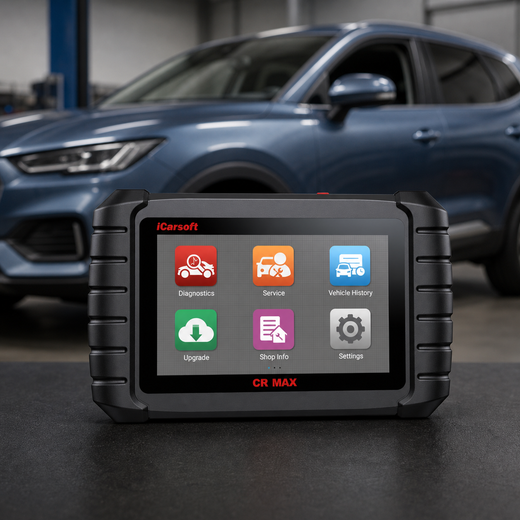
Save evidence before choosing a repair
iCarsoft CR MAX
Read supported Honda engine codes, freeze frame and live data to document the fault and compare results after a confirmed repair.
Check current CR MAX price and availabilityCheck CR MAX compatibility by VINDo not assume CR MAX can install every Honda calibration update or directly measure catalyst temperature. When a bulletin requires OEM programming equipment, approved software or a particular test, use that method and confirm compatibility in advance.
Know the measurement boundary. The scanner reports ECU information; it does not physically prove an exhaust leak, catalyst restriction, sensor wiring condition or internal converter damage. Use the required external test equipment and Honda procedures alongside the scan evidence.
Verify the P0420 Repair
Save the completed repair details, then clear erasable codes when directed. Check for current or pending misfire, mixture and sensor faults. Complete applicable setup and allow the catalyst monitor to run under the conditions specified for that Honda.
Recheck the monitor result, code status and symptoms. A clean idle or a few minutes with the light off does not prove the catalyst monitor has passed. Avoid repeated clearing, which can reset diagnostic information and delay a useful assessment.
A permanent P0420 can remain immediately after a successful repair. If the vehicle stores it as a permanent DTC, a scan tool or battery disconnect cannot erase it. Once current and pending faults are absent, the OBD system removes the permanent record only after the applicable monitor reruns and passes.
Related Catalyst, Mixture and Misfire Code Guides
P0420 Frequently Asked Questions
Does Honda P0420 always need a new catalytic converter?
No. The diagnostic sequence must consider engine faults, exhaust leaks, sensor/circuit evidence and applicable Honda software guidance. Replace the converter when the vehicle-specific tests support that repair, rather than from the code alone.
Should I replace the upstream or downstream oxygen sensor first?
Neither should be replaced by guesswork. Identify the sensor type, check companion codes and wiring, and test the response using the specified method. A wideband upstream A/F signal cannot be judged as if it were a conventional narrowband voltage.
Where is Bank 1 on my Honda?
Bank 1 contains cylinder 1. Its physical location depends on the engine installation. Use the VIN-specific cylinder-numbering and exhaust diagrams; do not assume a universal front, rear, driver-side or passenger-side location.
Can a misfire cause a P0420 problem?
An unresolved misfire or abnormal mixture can affect catalyst operation and may damage it. Diagnose those conditions first, then evaluate catalyst performance. Correcting the misfire does not guarantee an already damaged converter will recover.
How much will a Honda P0420 repair cost?
The price depends on the confirmed failure and Honda application. The Accord converter estimate in this guide is only one possible service. Diagnosis, sensor work, leaks and software follow different cost paths and require a vehicle-specific quote.
Why is P0420 still listed as permanent after repair?
A supported permanent emissions record is removed by the vehicle after its verification criteria are satisfied, not by a scan-tool clear command. Check current/pending faults and monitor results to distinguish a remaining record from an unresolved active failure.
Technical and cost references
- Honda Service Bulletin 22-040: MIL Is On With DTC P0420 — September 21, 2022, version 1
- Honda Service Bulletin 14-002: MIL is on with P0420 or P0430 — January 18, 2014
- RepairPal: Honda Accord Catalytic Converter Replacement Cost — updated September 3, 2026
- California BAR: Permanent Diagnostic Trouble Codes — Spring 2019
Product information: Official iCarsoft CR MAX page.
Editorial note: Use current manufacturer instructions for your VIN and qualified help for work beyond your training. A code identifies a test result, not a confirmed failed part.


