

Quick Answer
P0627 means Fuel Pump A Control Circuit/Open. The exact monitored path depends on the vehicle’s relay, pump-control module, and feedback design. It does not prove the in-tank pump is bad or identify a broken wire by itself. Save the complete report, map the control architecture, and compare the commanded state with electrical measurements and actual fuel delivery.
What Does the P0627 Code Mean?
The P0627 code concerns the control path used to operate the designated fuel pump. That path may involve a relay, a dedicated pump-control module, or another vehicle-specific arrangement. The monitored fault is not the same finding as low fuel pressure or a mechanically failed pump.
Keep four questions separate: did the controller request pump operation, did the relevant circuit provide the required electrical conditions, did the pump operate, and did the system deliver the required fuel pressure or flow? Answering one does not settle the others. A command on a screen is not a physical pressure measurement.
A refers to the control circuit designation in the service information. It does not universally identify the first pump in the tank, the high-pressure pump, a particular fuse, or one connector pin. Engine and fuel-system differences can change the hardware and the diagnostic path within the same model line.
Volkswagen’s January 2014 Golf/GTI reference book lists P0627 with application-dependent pump-control monitoring. That example shows why the circuit/open label must be read with the full manufacturer information. Use the exact engine’s diagnostic instructions rather than translating the code directly into one replacement part.
P0627 versus pump-control and fuel-pressure codes
| Code | General description | Key distinction |
|---|---|---|
| P0627 | Fuel pump A control circuit/open | Identify the monitored control path and feedback. |
| P0628 / P0629 | Pump-control circuit low / high | Different monitored electrical states; use the matching test branch. |
| P0230 | Fuel-pump primary circuit | Confirm the relay/control architecture for the vehicle. |
| P0087 | Fuel rail/system pressure too low | A pressure result, not proof of the same control-circuit fault. |
A silent pump does not prove it has failed. Some systems prime only under particular conditions. A running pump also does not prove adequate pressure, volume, or correct electrical supply.
P0627 Symptoms and Likely Causes
The effect depends on whether the fault is current and which control path is affected. Record starting behavior, the conditions before any stall, and companion codes. Do not assume a warning-only historical fault and a current no-start need identical immediate actions.
Fuel delivery may be absent, but ignition, synchronization, security authorization, and other no-start causes still need the correct diagnostic sequence.
An intermittent control or supply interruption can become unsafe in traffic. Arrange recovery when the vehicle cannot operate reliably.
A stored fault may reflect an intermittent event. Save status and available failure records before clearing it.
Companion codes can help identify a shared electrical problem or a separate pressure-control branch. They do not prove multiple failed parts.
Practical cause-checking order
- Connector or harness damage: Inspect the control module, relay area, tank wiring, and intermediate connections appropriate to the layout. Corrosion, poor terminal retention, water entry, chafing, or service-related damage can interrupt operation.
- Fuse, relay, supply, or ground fault: Check the complete circuit and any shared feeds. A fuse that opens again needs the cause identified; fitting a larger fuse or repeatedly replacing it is not a repair.
- Pump-control module or command/feedback issue: The module needs valid supply, grounds, control information, and its required load. Verify those conditions before deciding the module is internally faulty.
- Pump electrical or mechanical defect: A pump can fail, draw abnormal current, or fail to provide delivery despite running. Prove its required electrical conditions and test actual fuel performance using the correct procedure.
- Controller or configuration concern: Consider internal control faults or applicable software guidance only after external checks. Routine ECU flashing is not a general P0627 diagnostic step.
Do not bypass a fuel-pump relay, energize unidentified terminals, or defeat crash/security fuel shutoff. Fuel and electrical tests must follow the exact vehicle procedure with appropriate equipment.
How Serious Is P0627, and Can You Drive?
If the engine stalls, loses power unpredictably, or will not start reliably, normal road testing is inappropriate. Arrange a safe diagnosis or recovery. A temporary restart does not establish that an intermittent fuel-pump control fault is repaired.
With a steady warning and normal operation, seek prompt diagnosis and follow the owner’s manual. The code alone does not prove imminent engine damage or a certain remaining driving distance. Treat any fuel odor, visible leakage, smoke, or separate serious warning as its own immediate concern.
Stop and arrange a tow Stop safely and arrange help for fuel leakage, strong fuel odor, stalling, unsafe power loss, smoke, or fire risk. Do not continue repeated starting attempts around a suspected leak.
Work away from ignition sources with approved ventilation and fuel-handling equipment. Relieve pressure only by the manufacturer’s procedure. Direct-injection high-pressure systems need specific training; do not loosen a line to check for fuel. Keep test leads secure and prevent sparks near fuel vapors.
How to Diagnose P0627 in the Right Order
-
Save P0627 and define the actual starting or running fault
Record VIN, engine, fuel type, module identity, exact code wording and suffix, status, and available freeze-frame data. Save all module faults before clearing anything. Note whether the concern occurs during initial starting, after warm-up, over bumps, in wet conditions, or following tank, battery, or module work.
Distinguish a no-crank, crank/no-start, and running stall. They require different initial checks. Record relevant supply, security, communication, synchronization, and fuel-pressure faults without assuming P0627 explains every symptom. Codes created during intentional disconnection should be marked separately from the original report.
-
Map the fitted relay or fuel-pump control module
Obtain the exact wiring diagram and P0627 pinpoint test. Identify the pump designation, fuse and relay if fitted, module feeds and grounds, controller command path, feedback, splices, and connector views. Confirm whether the code concerns a low-pressure delivery circuit or another designated path on this engine.
Do not assume every fuel pump receives a simple continuous battery supply. A controller may use a modulated output or communicate through a separate command path. Identify that architecture before choosing a meter, scope, current clamp, or command test. Similar connector shapes do not establish compatible replacement hardware.
-
Inspect and prove the supply and ground paths
Inspect the relevant connectors, harness routing, relay or fuse connections, and module mounting area. Look for corrosion, damaged seals, loose terminals, pinched wiring, and overheating. Use the VIN-specific diagram to trace shared feeds rather than replacing every component that appears in a scan report.
Perform the prescribed loaded supply and ground tests with suitable instruments. An unloaded voltage at an unplugged connector does not prove the circuit can support pump operation. A relay click does not prove its contacts carry the required load. If a fuse has failed, diagnose the load and wiring before re-energizing the circuit.
-
Compare the command, module response, and pump current
On a supported vehicle, use the exact OEM pump output test or operating condition. Observe available command and feedback data while measuring the specified electrical response. Confirm authorization and test prerequisites; an unavailable or inhibited command does not automatically prove a pump or control module failure.
Follow the required method for a modulated supply or feedback signal. A meter’s averaged reading may need waveform or current evidence for interpretation. Measure at the prescribed points and document the state. Do not use a scanner label such as “pump on” as proof of wiring integrity or actual pump movement.
-
Test actual fuel delivery without confusing it with control
When the electrical branch calls for delivery testing, use an approved pressure gauge, transducer, or specified scan-data method appropriate to the system. Compare required and actual pressure under the stated conditions. Confirm that a reported pressure PID is valid before relying on it as a physical result.
A pump can run yet fail the required pressure or flow test; a control interruption can also prevent delivery from a sound pump. Separate those outcomes. Do not apply a universal fuel-pressure number or infer a failed high-pressure pump from a low-pressure control fault. Never loosen high-pressure fuel lines as a test.
-
Repair the proven fault and verify complete operation
Repair the identified terminal, wire, supply path, relay, module, or pump using approved parts and sealing methods. Confirm part identity, required module setup, and any fuel-system priming procedure. Avoid routine controller programming or replacing an entire tank assembly when the diagnostic evidence identifies a repairable external connection.
Restore all connectors and protection, then check for leakage using the approved method. Repeat the original command, electrical, and delivery tests under safe conditions. Save the after-repair report before clearing erasable codes as directed. Confirm reliable starting and operation; one temporary restart is not sufficient verification of an intermittent fault.
Specifications are vehicle-specific. Use the exact circuit identification, supply and waveform criteria, pump-current method, fuel-pressure limits, and test conditions for the VIN. No universal relay pinout, duty cycle, current draw, or pressure value is supplied here.
P0627 Repairs and Cost Factors
A useful P0627 repair restores the control path and the required fuel delivery. A bad terminal needs a durable connection repair; a defective relay or module needs the tests proving that failure; a pump replacement needs correct electrical and delivery evidence. Keep the results with the estimate.
Use the correct fuel-system part and installation procedure. A module replacement may require setup on one vehicle and a different process on another. Follow matching OEM information for software work, and verify operation after any required programming rather than presenting an ECU update as routine maintenance for this code.
| Possible path | US quote requirements |
|---|---|
| Control-circuit diagnosis | Include architecture identification, loaded measurements, and command/feedback checks. |
| Connector or relay repair | Quote approved terminals, sealing, access labor, and the proven supply defect. |
| Fuel-pump control module | Identify the failed test, correct module, setup requirements, and verification. |
| Pump or delivery repair | Include the confirmed pressure/flow result, access, seals, priming, and leak checks. |
Request a VIN-specific written quote after isolation. Tank access, module location, corrosion, intermittent testing, and required setup change the work involved. Separate diagnosis, parts, labor, taxes, and verification. Compare estimates for the same confirmed repair rather than approving a pump solely from the code number.
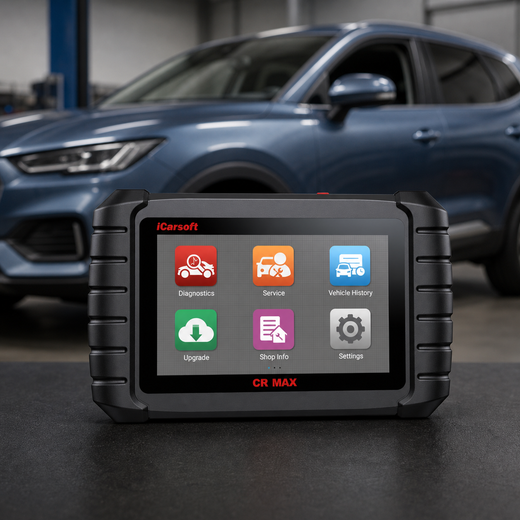
Using iCarsoft CR MAX for P0627
The official iCarsoft CR MAX page lists all-system diagnostics and bidirectional control. Confirm the exact engine, fuel-pump controller, live-data PIDs, and output test before purchase. Broad product capability does not guarantee every VIN-specific pump command or module setup routine.
Use supported scan data to build the diagnostic timeline. Compare requested operation, controller feedback, and available pressure information under the same test conditions. Keep meter, current, waveform, and physical delivery results with the scan report so the electrical and fuel sides of the diagnosis remain distinguishable.
Save evidence before choosing a repair
iCarsoft CR MAX
On a supported vehicle, the CR MAX helps record the full fault context and compare available pump command, feedback, and fuel-system data.
Check current CR MAX price and availabilityCheck CR MAX compatibility by VINRun a pump active test only when supported and specified by the manufacturer. The scanner cannot physically test a fuse, load a circuit, measure pump current, or prove fuel pressure through a software command. It should not be advertised as universal ECU flashing or fuel-pump module programming equipment.
Know the measurement boundary. Physical voltage drop, current, waveform, resistance, fuel pressure, flow, and leakage require the specified external instruments and inspection. Supported scan data complements these checks; it does not replace them.
Verify the P0627 Repair
Confirm safe fuel-system sealing and reliable control response after reassembly. Repeat the original failure conditions without exposing the driver or technician to an unsafe stall. Recheck measured supply, ground, pump response, and required delivery. Save the final scan report and test conditions.
Clear erasable faults only after preserving evidence and repairing the cause. Check current and pending status and any available monitor results. Clearing may reset readiness. A supported permanent emissions DTC clears through the vehicle’s qualifying monitor, not a forced erase or battery disconnect.
A permanent P0627 can remain immediately after a successful repair. If the vehicle stores it as a permanent DTC, a scan tool or battery disconnect cannot erase it. Once current and pending faults are absent, the OBD system removes the permanent record only after the applicable monitor reruns and passes.
Related fuel delivery and electrical supply Code Guides
P0627 Frequently Asked Questions
Does P0627 mean the fuel pump must be replaced?
No. The control architecture, supply, grounds, wiring, relay or module, and actual delivery need testing. The code alone cannot identify the failed part.
Does A mean the in-tank pump on every vehicle?
No. A is the designated control path in the manufacturer information. Confirm the exact pump and circuit from the engine’s diagram and full fault text.
Does hearing the pump prove it is good?
No. Sound can indicate activity without establishing correct supply, current, pressure, or flow. Use the specified electrical and delivery tests.
Can a scanner test the wiring or fuel pressure directly?
It can report supported controller data and request supported functions. Physical electrical and fuel measurements require the correct instruments; a command is not proof of delivery.
Should the ECU be flashed for P0627?
Only if matching current OEM guidance and completed diagnostics require software work. Flashing is not a routine remedy for an external circuit, relay, or pump defect.
How is the P0627 repair verified?
Confirm the repaired control path, measured electrical conditions, required fuel delivery, reliable starting and operation, and relevant code status under the original safe test conditions.
Technical references
Product information: Official iCarsoft CR MAX page.
Editorial note: Use current manufacturer instructions for your VIN and qualified help for work beyond your training. A code identifies a test result, not a confirmed failed part.


